Sign Up For a Webinar

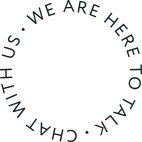


In this season of gratitude, it鈥檚 appropriate to recall the 鈥渇our freedoms鈥� 鈥� freedom of speech, freedom of worship, freedom from fear, and freedom from want 鈥� articulated by President Franklin D. Roosevelt at the threshold of World War II and illustrated so memorably in Norman Rockwell鈥檚 iconic renditions.
Eleven months before the attack on Pearl Harbor, with Europe under siege and Congress leery of getting involved, Roosevelt sought to remind the American people that the freedoms we sometimes take for granted must be nurtured and guarded. In his State of the Union address on Jan. 6, 1941, Roosevelt proposed four essential, bedrock freedoms that people 鈥渆verywhere in the world鈥� have a right to enjoy.
The first two freedoms he cited鈥攕peech and religion鈥攁re of course enshrined in the First Amendment. The other two 鈥� freedom from want and from fear 鈥� are nowhere to be found in the Constitution. Rather, they relate to Roosevelt鈥檚 Depression-era commitment to economic security (freedom from want) and his efforts to establish the United Nations (freedom from fear).
It fell to Rockwell to translate those abstract concepts into four scenes of everyday American life that would capture the minds and hearts of his countryman, a task he initially thought was beyond his capabilities. History has proven him quite wrong, and those four images are among his most famous.
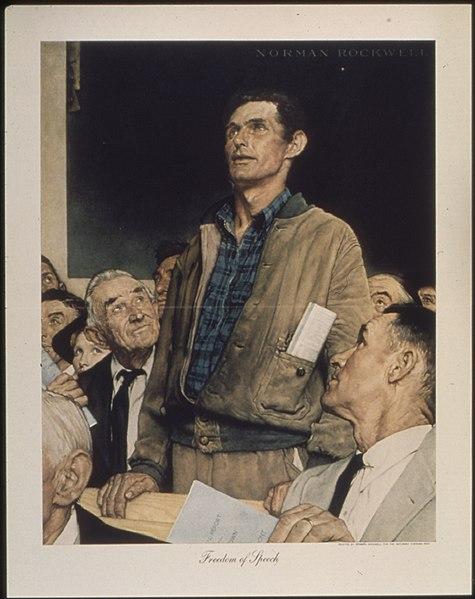
Freedom of Speech depicts a blue-collar man, wearing a plaid shirt and suede jacket, standing among the crowd at a government meeting to voice his opinion. The others in the painting are well dressed, wearing shirts and ties and jackets, but they listen respectfully as this workingman speaks his mind.
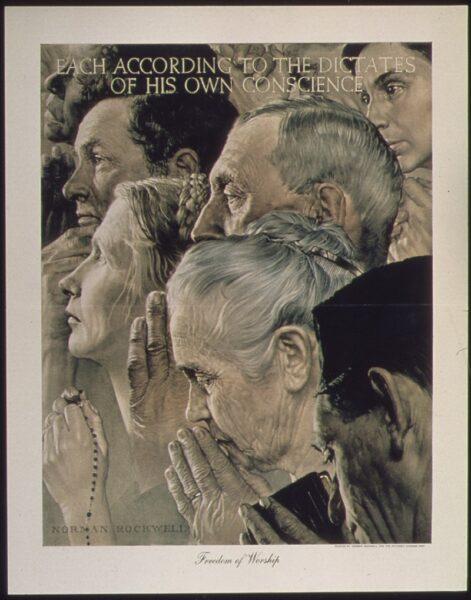
Freedom of Worship, under the title 鈥渆ach according to the dictates of his own conscience,鈥� shows eight people of different faiths in a moment of prayer. One of them, with his head covered and holding a religious book, is Jewish. A young woman with rosary beads represents Catholics. An older woman, praying devoutly, embodies Protestantism. It鈥檚 a tribute to religious diversity.
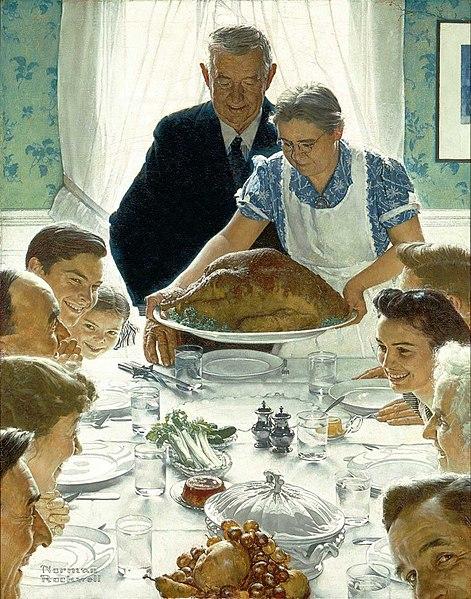
Freedom from Want is a Thanksgiving scene in which an aproned matriarch presents a turkey to her family, depicted by three generations breaking bread together at their dining room table. The illustration represents traditional American family values: togetherness, harmony, peace, and abundance.
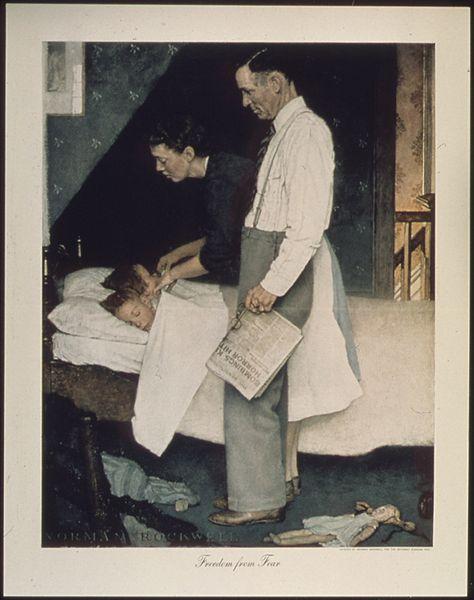
And Freedom from Fear shows children nestled safely in their bed, oblivious to the carnage occurring across the ocean. Their mother tucks them in and their father holds a newspaper with a headline announcing the Nazi blitz of London, where the scene would be much different and where the lives of everyone, including innocent children, were in jeopardy.
As we approach Thanksgiving, it鈥檚 worthwhile to re-examine the four illustrations and ponder their meaning and message at a time when the nation seems so terribly divided over 鈥� let鈥檚 be frank 鈥� fleeting issues that often don鈥檛 amount to a hill of beans. It often seems that half of our country is perpetually mad at the other half. Are we really that different? Are our differences really irreconcilable? I don鈥檛 think so. Actually, I think we鈥檙e much more alike than different, and I believe that as a society we share core values that matter infinitely more than ephemeral political squabbles. Those values, captured by Norman Rockwell, are what bind us as a nation.
Let鈥檚 count our blessings, send our prayers to the suffering people of the Middle East and the Ukraine, take a deep breath, and maybe revisit Rockwell鈥檚 Four Freedoms. And let鈥檚 ponder what those 80-year-old illustrations say not only about us as Americans, but us as human beings.